
1) Luke 22:39-46
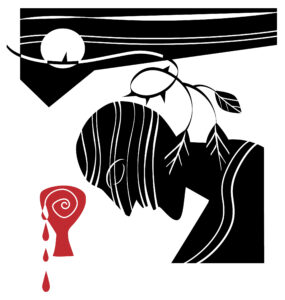
39 And [Jesus] came out and went, as was his custom, to the Mount of Olives, and the disciples followed him. 40 And when he came to the place, he said to them, “Pray that you may not enter into temptation.” 41 And he withdrew from them about a stone’s throw, and knelt down and prayed, 42 saying, “Father, if you are willing, remove this cup from me. Nevertheless, not my will, but yours, be done.” 43 And there appeared to him an angel from heaven, strengthening him. 44 And being in an agony he prayed more earnestly; and his sweat became like great drops of blood falling down to the ground. 45 And when he rose from prayer, he came to the disciples and found them sleeping for sorrow, 46 and he said to them, “Why are you sleeping? Rise and pray that you may not enter into temptation.”
Already here, it is written that our Lord is in agony. He is not yet being physically beaten or scourged. And yet He suffers deeply in both body and soul. For He is in a very real sense carrying the weight of the world here. Gethsemane means “olive press” where olive oil was pressed out. Here Jesus experiences the greatest of pressing and pressure, as even the blood is pressed out of His body with His sweat that falls to the ground. He knows the suffering that lies before Him. Above all, Jesus does not wish to be cut off from His Father whom He loves with perfect love. That the Father would turn His back on Him at the cross was an unbearable thought. But this Jesus does for you. He submits Himself to the Father’s will out of love for you, that you may share in His love with the Father. His bloody sweat covers you who are made from the dust and redeems you.
Remember Jesus’ agony when you yourself are in mental or emotional anguish, when the weight of the world seems to be pressing down on you, when you are pressed or depressed, and there seems to be no way of escape. Remember Jesus, who did not escape, so that you will not be tempted or tested beyond what you can bear. He is your escape. He is your rest and your refuge. He drank the cup of judgment, so that now there is no condemnation for you who are in Christ Jesus. You are given to drink the cup of salvation. The cup of God’s mercy overflows to you in Jesus.
Prayer: Lord,
grant us your strength and wisdom,
that we may seek to follow your will in all things.
2) Mark 14:43-50
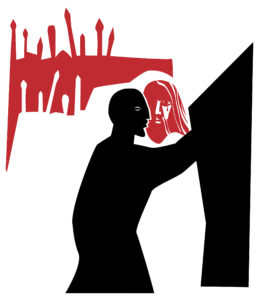
43 And immediately, while he was still speaking, Judas came, one of the twelve, and with him a crowd with swords and clubs, from the chief priests and the scribes and the elders. 44 Now the betrayer had given them a sign, saying, “The one I will kiss is the man. Seize him and lead him away under guard.” 45 And when he came, he went up to him at once and said, “Rabbi!” And he kissed him. 46 And they laid hands on him and seized him. 47 But one of those who stood by drew his sword and struck the servant of the high priest and cut off his ear. 48 And Jesus said to them, “Have you come out as against a robber, with swords and clubs to capture me? 49 Day after day I was with you in the temple teaching, and you did not seize me. But let the Scriptures be fulfilled.” 50 And they all left him and fled.
Swords and clubs are instruments of power and force and coercion. They are what the chief priests and scribes and elders wield to lay hold of Jesus. They are what even Peter tries to use to defend Jesus. But for both it is in vain. God’s kingdom cannot be established by the use of force and worldly power; God’s kingdom cannot be stopped or undone by the use of force and worldly power. For His kingship is exercised not through coercing His subjects but through the giving of Himself for His subjects. In love He rules the hearts of His people through faith. We dare never put our trust in the powers of this world to establish or save the church. We dare never behave as Peter did and think the success of the Gospel is dependent on our wisdom and strength. The Gospel thrives precisely in apparent weakness and defeat.
Even in the midst of the physical roughness here, the most hurtful thing that is done is Judas’ betrayal. As a true man, Jesus feels the human hurt of having a friend and follower stab Him in the back, all with a smile and a kiss, all while your companions flee for cover. Remember this when people deceive and betray and use you for their own ends, when they bring you to tears. Jesus has been there for you, He is with you in your hurt to deliver you, to vindicate all who take refuge in Him.
Prayer: Lord, grant us a willingness to suffer for your name’s sake,
to depend on the strength of your words
and not on worldly institutions and power.
3) Mark 14:55-65
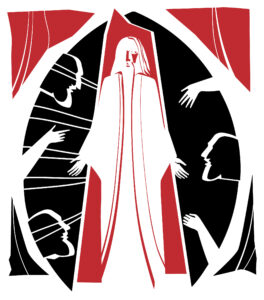
55 Now the chief priests and all the council sought testimony against Jesus to put Him to death, but found none. 56 For many bore false witness against Him, but their testimonies did not agree.
57 Then some rose up and bore false witness against Him, saying, 58 “We heard Him say, ‘I will destroy this temple made with hands, and within three days I will build another made without hands.’” 59 But not even then did their testimony agree.
60 And the high priest stood up in the midst and asked Jesus, saying, “Do You answer nothing? What is it these men testify against You?” 61 But He kept silent and answered nothing.
Again the high priest asked Him, saying to Him, “Are You the Christ, the Son of the Blessed?”
62 Jesus said, “I am. And you will see the Son of Man sitting at the right hand of the Power, and coming with the clouds of heaven.”
63 Then the high priest tore his clothes and said, “What further need do we have of witnesses? 64 You have heard the blasphemy! What do you think?”
And they all condemned Him to be deserving of death.
65 Then some began to spit on Him, and to blindfold Him, and to beat Him, and to say to Him, “Prophesy!” And the officers struck Him with the palms of their hands.
“As a lamb before its shearer is silent, so He opened not His mouth.” For Jesus had not come to defend Himself against false accusations but to defend us against the true accusations that the devil would lay against us. Jesus allows Himself to be condemned in our stead.
Put under oath, He speaks the truth of who He is, the Christ, the Son of the Blessed, who will come again on the Last Day for judgment. But here in His first coming, He allows Himself to be placed under judgment, that there might be deliverance from the final judgment for all who take shelter under His wings.
Jesus had used His spittle to heal, to give sight. Now He is spit upon by those who are blind to who He is–that He is the true temple, where God’s presence dwells in bodily form. He will be destroyed in death and then raised up in glory on the third day, that the people of God might have an eternal dwelling in Him.
Prayer: Lord, grant us the courage to confess You as the Way, the Truth, and the Life,
even in the face of hostility and enmity,
that we may honor your name in life and in death.
4) Luke 22:54-62
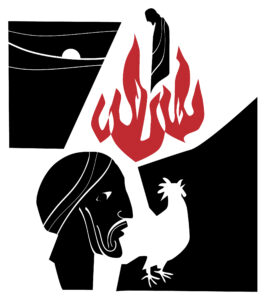
54 Having arrested Him, they led Him and brought Him into the high priest’s house. But Peter followed at a distance. 55 Now when they had kindled a fire in the midst of the courtyard and sat down together, Peter sat among them. 56 And a certain servant girl, seeing him as he sat by the fire, looked intently at him and said, “This man was also with Him.”
57 But he denied Him, saying, “Woman, I do not know Him.”
58 And after a little while another saw him and said, “You also are of them.”
But Peter said, “Man, I am not!”
59 Then after about an hour had passed, another confidently affirmed, saying, “Surely this fellow also was with Him, for he is a Galilean.”
60 But Peter said, “Man, I do not know what you are saying!”
Immediately, while he was still speaking, the rooster crowed. 61 And the Lord turned and looked at Peter. Then Peter remembered the word of the Lord, how He had said to him, “Before the rooster crows, you will deny Me three times.” 62 So Peter went out and wept bitterly.
Peter has three chances to confess that he knows Christ. Three times Peter fails. He would have to live for a while with the overwhelming emptiness of his disloyalty and failure. We know that weakness of the flesh, too, when we deny Jesus with our words or behavior, seeking to avoid negative consequences to our reputation or our income or our life. Apart from Christ, Peter can do nothing, in spite of his good intentions.
Jesus had told Peter this would happen. When it occurs, as the rooster crows, as Jesus is condemned by the Sanhedrin, He turns and looks at Peter who is there in the courtyard. Jesus did this not simply to cut proud Peter down to size, but also to teach Peter that His love would remain despite Peter’s sin. This was not a look of anger, but of sorrowful compassion. Peter would call Jesus’ words to mind and weep. But he would also realize that Jesus didn’t reject him even though He knew this about him ahead of time. So also with you–Jesus knows how you will stumble and falter. And yet He doesn’t reject you; He sticks with you despite yourself. The rooster’s crow is not only a call to repentance but also a call to faith in Jesus, who looks on you with constant love.
Prayer: Lord, strengthen us to faithfully confess you before men,
that You also confess us before your Father in heaven.
5) Mark 15:1-15
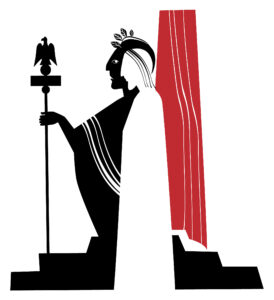
15 Immediately, in the morning, the chief priests held a consultation with the elders and scribes and the whole council; and they bound Jesus, led Him away, and delivered Him to Pilate. . .
6 Now at the feast Pilate was accustomed to releasing one prisoner to them, whomever they requested. 7 And there was one named Barabbas, who was chained with his fellow rebels; they had committed murder in the rebellion. 8 Then the multitude, crying aloud, began to ask him to do just as he had always done for them. 9 But Pilate answered them, saying, “Do you want me to release to you the King of the Jews?” 10 For he knew that the chief priests had handed Him over because of envy.
11 But the chief priests stirred up the crowd, so that he should rather release Barabbas to them. 12 Pilate answered and said to them again, “What then do you want me to do with Him whom you call the King of the Jews?”
13 So they cried out again, “Crucify Him!”
14 Then Pilate said to them, “Why, what evil has He done?”
But they cried out all the more, “Crucify Him!”
15 So Pilate, wanting to gratify the crowd, released Barabbas to them.
The name Barabbas means “son of the Father.” But this Barabbas did not act like a child of God, but of the evil one. He was a murderer in the rebellion. And so Barabbas represents us. For all sin ultimately is rebellion against God. It is the attempted murder of God, to get Him out of your way so that you can run things the way you want without any interference or consequences. This is what the chief priests were doing. They handed Jesus over because of envy, because He was a threat to their plans and their power. They were a more pious version of Barabbas, rebelling against God in the name of religion and good order, very literally seeking to murder God the Son.
And the Father allows them to succeed. And their success is their undoing. Evil is overcome by getting its way. The wicked fall into their own trap. Sin and death and the devil are overcome by the crucifixion of Jesus. Justice is satisfied by this injustice. Christ takes our place in death so that we may be real Barabbases, real sons of the Father through Him. The Savior is made to be sin so that we are made to be true children of God in Christ.
Prayer: Lord, grant us discernment
that we may see as you see, not as the world sees.
6) John 19:1-5
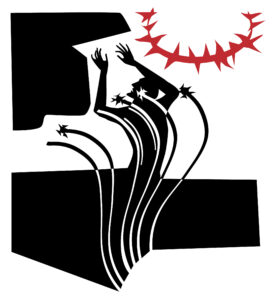
19 So then Pilate took Jesus and scourged Him. 2 And the soldiers twisted a crown of thorns and put it on His head, and they put on Him a purple robe. 3 Then they said, “Hail, King of the Jews!” And they struck Him with their hands.
4 Pilate then went out again, and said to them, “Behold, I am bringing Him out to you, that you may know that I find no fault in Him.”
5 Then Jesus came out, wearing the crown of thorns and the purple robe. And Pilate said to them, “Behold the Man!”
The first time we hear of thorns in the Bible is in Genesis after Adam and Eve fell into sin. God spoke a curse on the ground saying, “thorns and thistles it shall bring forth for you.” The very ground out of which man was created will itself turn against him. No longer will food come easily as it did in Paradise. Now it will come only with thorny and sweaty labor.
Behold the kind of king we have then in Jesus. He is one who is willing to bear sin’s curse, literally wearing it on His head in order to break the curse and release us from it. Here is your king, who doesn’t parade His wealth with gold and jewels in His crown, but who manifests His love with blood stained thorns. There is no fault in Him, as Pilate said. But He bears all of your faults. And they died with Him. No need to beat yourself up over them any more. Jesus your king has freed you and given you new life. By His wounds you are healed.
Prayer: Lord, grant us patience in times of suffering
that we may offer our lives as a sacrifice of praise.
7) John 19:14-17
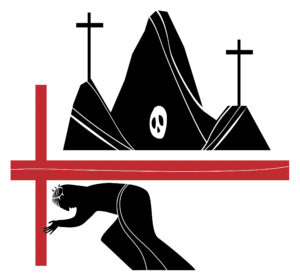
14 Now it was the Preparation Day of the Passover, and about the sixth hour. And he said to the Jews, “Behold your King!”
15 But they cried out, “Away with Him, away with Him! Crucify Him!”
Pilate said to them, “Shall I crucify your King?”
The chief priests answered, “We have no king but Caesar!”
16 Then he delivered Him to them to be crucified. So they took Jesus and led Him away.[a]
17 And He, bearing His cross, went out to a place called the Place of a Skull, which is called in Hebrew, Golgotha.
Golgotha, Place of a Skull. What happens with the skull, with the head, is a key theme of salvation and deliverance in Scripture. The very first explicit promise of the Gospel in Scripture is that the Redeemer would crush the serpent’s head. When God gave victory over the enemies of His people, there were many times when the taking of the enemy’s head was a sign of triumph. Goliath was decapitated. Jael pounded the tent peg through the temple of Sisera’s head.
Now, our final and ultimate deliverer carries His weapon, His cross to the Place of a Skull. There He drives His cross into the Skull like a sword, to defeat the power of death, to destroy the work of the devil. Though Jesus’ feet are pierced, yet those same feet crush Satan’s head and pulverize the power of the grave.
This is why Jesus bears His cross. This is why He allows Himself to be delivered over to be crucified, to trample the powers of darkness and bring you as His own into His kingdom of light, where you will serve Him in everlasting righteousness, innocence, and blessedness.
Prayer: Lord, grant, we pray, a spirit of gratitude for how you redeemed us,
not with gold or silver, but with your holy precious blood and with your innocent suffering and death.
8) Mark 15:21
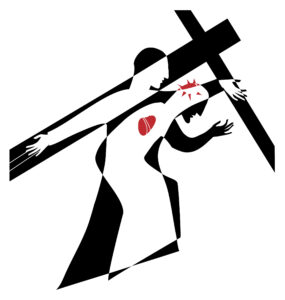
21 Then they compelled a certain man, Simon a Cyrenian, the father of Alexander and Rufus, as he was coming out of the country and passing by, to bear His cross.
Jesus is so weak from the beatings and the flogging He has endured that He can only carry the cross for a short distance. The lack of sleep, the loss of blood, the weight of the world’s sin causes Him to fall beneath the burden of the cross.
And so a man named Simon of Cyrene is compelled to carry Jesus’ cross. Simon was in the city for the Passover feast and was probably pulled out of the crowd randomly by the Roman soldiers to do this duty. And yet it wasn’t entirely by chance that this happened. For God chose Simon to perform this special task which would give a vivid picture of Jesus’ own words, “If anyone would come after Me, he must deny himself and take up the cross and follow Me.”
So it is for you. In your baptism you were chosen by God to bear the cross. You received the sign of the holy cross on your forehead and on your heart to mark you as one redeemed by Christ the crucified. You are given to carry that cross daily, bearing the burdens of the callings into which God has placed you, sometimes suffering because of faithfulness to the truth of Christ.
But notice the fundamental distinction between you and Christ. Though you take up the cross, yet you do not bear the judgment against sin. That’s all on Jesus. He bears the real burden. He bids you to follow after Him beneath the cross that you may receive all the benefits of His suffering. That’s how it is that Jesus can say, “Take my yoke upon you and learn from Me, for I am gentle and humble in heart, and you will find rest for your souls. For My yoke is easy, and My burden is light.” Freed by Jesus’ cross from the crushing weight of sin’s curse, we find it to be a light load that brings rest and peace to our souls.
Prayer: Lord, grant us strength of purpose
that we may faithfully bear our crosses each day.
9) Luke 23:27-31
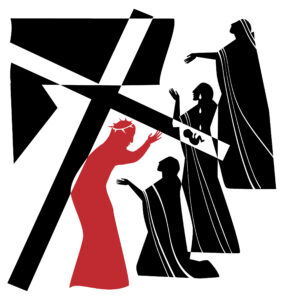
27 And a great multitude of the people followed Him, and women who also mourned and lamented Him. 28 But Jesus, turning to them, said, “Daughters of Jerusalem, do not weep for Me, but weep for yourselves and for your children. 29 For indeed the days are coming in which they will say, ‘Blessed are the barren, wombs that never bore, and breasts which never nursed!’ 30 Then they will begin ‘to say to the mountains, “Fall on us!” and to the hills, “Cover us!”’ 31 For if they do these things in the green wood, what will be done in the dry?”
The faithful women mourn what is happening to Jesus, to their Lord and Teacher. They are powerless to stop it. But that is not a cause for weeping. Jesus tells the women rather to weep for themselves at what is coming, great tribulation for the faithful. Weep for a world that is dry wood without the Gospel, that brings upon itself disorder and chaos and pain by its faithlessness, that invites God’s judgment. Both the earth and the works that are in it will be burned up.
Jesus’ cross is green wood for us, flowing with life, bearing the fruit of salvation for us. Weep only for where that fruit is rejected. Weep only that the ingratitude for God’s mercy finally brings judgment and death for those who refuse Him. Pray for those who are unrepentant, that they may be granted penitent hearts and be restored to God through Christ, and may eat of the green tree of life.
Prayer: Lord, grant us gentle spirits
that we may comfort those who mourn.
10) Luke 23:33-34
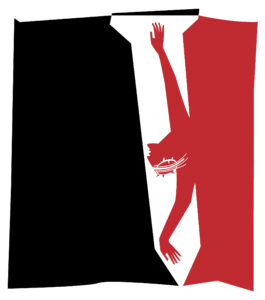
33 And when they had come to the place called Calvary, there they crucified Him, and the criminals, one on the right hand and the other on the left. 34 Then Jesus said, “Father, forgive them, for they do not know what they do.”
And they divided His garments and cast lots.
Jesus is numbered with the transgressors, treated as a common criminal and worse, just one of three men receiving the death penalty. There He is, not above it all, distant, keeping His hands clean, but right in the middle of it all, being dirtied with our sin, that we might be cleansed forever.
Our Lord Jesus is slow to anger, abounding in steadfast love, even for the very ones who crucified Him. “Father forgive them, for they know not what they do.”
Sin makes us ignorant. We don’t know what we’re doing. Even when we do know we’re doing something wrong, we don’t grasp how deeply we are hurting others and ourselves. We don’t know how we are slapping God in the face. But Jesus prays for us, anyway, “Father, forgive them.” Here is the ultimate picture of God’s love for us, that He dies for sinners, even for His enemies, His persecutors. Before we could ever ask Him for help or seek His forgiveness, He was already there to save and redeem us. He doesn’t require us to change before He’ll love us. His forgiving love is the very power that changes us.
Jesus’ prayer to His Father is surely heard, and so your sins are surely forgiven. He has borne the nakedness of your shame so that you may be covered with His garments of mercy.
Prayer: Lord, grant us merciful hearts
that we may love our enemies and persecutors
and bring your reconciliation and forgiveness to all.
11) Luke 23:39-43
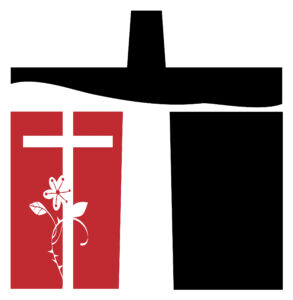
39 Then one of the criminals who were hanged blasphemed Him, saying, “If You are the Christ, save Yourself and us.”
40 But the other, answering, rebuked him, saying, “Do you not even fear God, seeing you are under the same condemnation? 41 And we indeed justly, for we receive the due reward of our deeds; but this Man has done nothing wrong.” 42 Then he said to Jesus, “Lord, remember me when You come into Your kingdom.”
43 And Jesus said to him, “Assuredly, I say to you, today you will be with Me in Paradise.”
Jesus was mocked so thoroughly that even one of those who was crucified with Him joined in, telling Him to save them if He was the Christ. Of course, that’s exactly what Jesus was doing. But this criminal couldn’t see that. Even in death he was not repentant for his sins but was full of anger and denial. He was a goat at Jesus’ left hand.
But there is also a sheep at Jesus’ right hand. Learn from this second criminal how to come before God. Do not complain in bitter anger at God for the crosses in your life, many of which are caused by our own foolishness; for those crosses are for the putting to death of your old sinful nature. Look to Christ in repentance; trust in Him. His steadfast love endures forever. Pray with the thief on the cross, “Lord, remember me when You come into Your kingdom.”
How gladly the repentant thief must have received Jesus’ reply, words that will apply to you and to all Christians on the day of your death, “Today, you will be with Me in Paradise.” That’s what Paradise is, to be with Christ. Where Christ is, there is heaven, where the curse of sin and death is no more, where there is no sorrow or pain or crying. It is to be restored to communion with God in a way that is even closer and deeper and better than what Adam and Eve knew in the Garden. To be in Christ’s merciful presence is to have the fullness of life and joy and peace.
Prayer: Lord, grant us perseverance,
that we may never stop seeking you
until we are with You in Paradise.
12) John 19:25-27
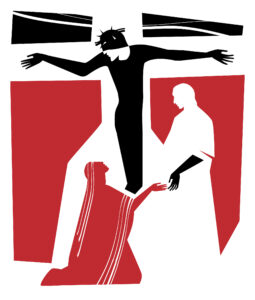
25 Now there stood by the cross of Jesus His mother, and His mother’s sister, Mary the wife of Clopas, and Mary Magdalene. 26 When Jesus therefore saw His mother, and the disciple whom He loved standing by, He said to His mother, “Woman, behold your son!” 27 Then He said to the disciple, “Behold your mother!” And from that hour that disciple took her to his own home.
When we suffer, we tend to meditate on our pain, even to wallow in it. We find it hard to get outside of ourselves and focus on others. But not our Lord Jesus. In His final hours He is thinking not of Himself, but is making sure that His mother is cared for properly. Jesus had other brothers and sisters who might have looked after Mary. But the Scriptures remind us that not even they believed that Jesus was who He said He was. And so our Lord places His mother into the care of John, who stood by Him with Mary in her hour of need, even as John is placed into her care as her son. It was important that Mary be placed into the hands of one who was faithful to Christ.
For Mary is a picture of the Church, which has given birth to us all in baptism as members of the body of Christ. And John is a picture of the Church’s pastors, who in turn care for her in the ministry of the Word and the Sacraments. These words of Jesus apply also to us, then, as pastor and congregation, “Woman behold your son.” “Behold, your mother.” Our Lord cares for us from the cross, setting the solitary into the family of the church and bringing comfort to those who mourn.
Prayer: Lord, grant us constancy
that we may be willing to stand by those in need.
13) Luke 23:44-46
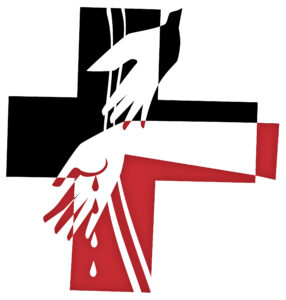
44 Now it was about the sixth hour, and there was darkness over all the earth until the ninth hour. 45 Then the sun was darkened, and the veil of the temple was torn in two. 46 And when Jesus had cried out with a loud voice, He said, “Father, ‘into Your hands I commit My spirit.’” Having said this, He breathed His last.
Darkness covers the land at midday, in token of the darkness of judgment that Jesus was enduring. It’s as if the sun itself could not bear to look at the death of the Son of God and hid its face.
Jesus’s final words, though, are confident words of faith and trust in His Father. They are from Psalm 31. “In you, O Lord, I trust. . . quickly deliver me! . . . For you are my rock and my fortress . . . You will bring me out of the net they hid for me, for you are my stronghold. Into your hands I commit my spirit; you have redeemed me, O Lord, God of truth. . . I will rejoice and be glad in your faithfulness.” After Jesus’ other anguished words on the cross, here Jesus expresses assurance in His Father’s love and faithfulness. He breathes His last, certain that the Father will deliver Him and raise Him up again.
At this moment of His death He entrusts His life to His Father. He dies like a child falling asleep in the arms of his father. Remember these words of Jesus when the time comes for you to breathe your last breath. Remember that by entrusting Himself to the Father, Jesus has entrusted you to the Father. Your spirit even now is held safely in His hands. As the baptized you live in Christ, and He is in the Father. When you are experiencing affliction in your last days and last moments, you also are given to pray these words with peaceful trust and to breathe your last knowing that God will deliver you, too, and raise you up again. “Father, into Your hands I commit My spirit.”
Prayer: Lord, grant us faith in you,
that when our time on earth is ended, we may confidently entrust ourselves into Your hands.
14) Mark 15:42-47
42 Now when evening had come, because it was the Preparation Day, that is, the day before the Sabbath, 43 Joseph of Arimathea, a prominent council member, who was himself waiting for the kingdom of God, coming and taking courage, went in to Pilate and asked for the body of Jesus. 44 Pilate marveled that He was already dead; and summoning the centurion, he asked him if He had been dead for some time. 45 So when he found out from the centurion, he granted the body to Joseph. 46 Then he bought fine linen, took Him down, and wrapped Him in the linen. And he laid Him in a tomb which had been hewn out of the rock, and rolled a stone against the door of the tomb.
Joseph of Arimathea was a member of the Sanhedrin, the very group that had condemned Jesus to death. Perhaps he had spoken up but was greatly outnumbered at Jesus’ trial. Perhaps he had not spoken up at all. But here he takes courage, and goes to Pilate the governor, and asks for the body of Jesus, that Jesus might be given an honorable burial, and not be left for the vultures.
It may be that you identify with Joseph, feeling outnumbered in your life when it comes to the things of Jesus, sometimes remaining silent for lack of courage. Let us then stand with Joseph now and take courage. In the light of Jesus’ death, we see that nothing else is so important as our Lord and His holy cross, even in the face of untrustworthy civil authorities. Let us ask for the body of Jesus, seeking the Holy Sacrament of His body and blood every week, that we may honor His Word and be honored by the gifts that He gives to us in His Supper.
Jesus is buried in a new tomb hewn out of rock. For He has come to be Rock of our salvation by conquering the grave, bringing new life out of death. By being laid in the tomb, He has truly made your grave a place of Sabbath rest, of peace, from which you will awaken in the resurrection to everlasting life. And so we say with the Psalmist, “In God is my salvation and my glory; The rock of my strength, and my refuge, is in God.”
Prayer: Lord Jesus Christ, your passion and death is the sacrifice that unites earth and heaven and reconciles all people to you. May we who have reflected on these mysteries follow in your steps and so come to share your glory in heaven, where you live and reign with the Father and the Holy Spirit one God, now and forever.
Icons are by Nicholas Markell, copyright 2013, and can be purchased here.