

Matthew 5:17-26
Trinity 6
✠ In the name of the Father and of the Son and of the Holy Spirit ✠
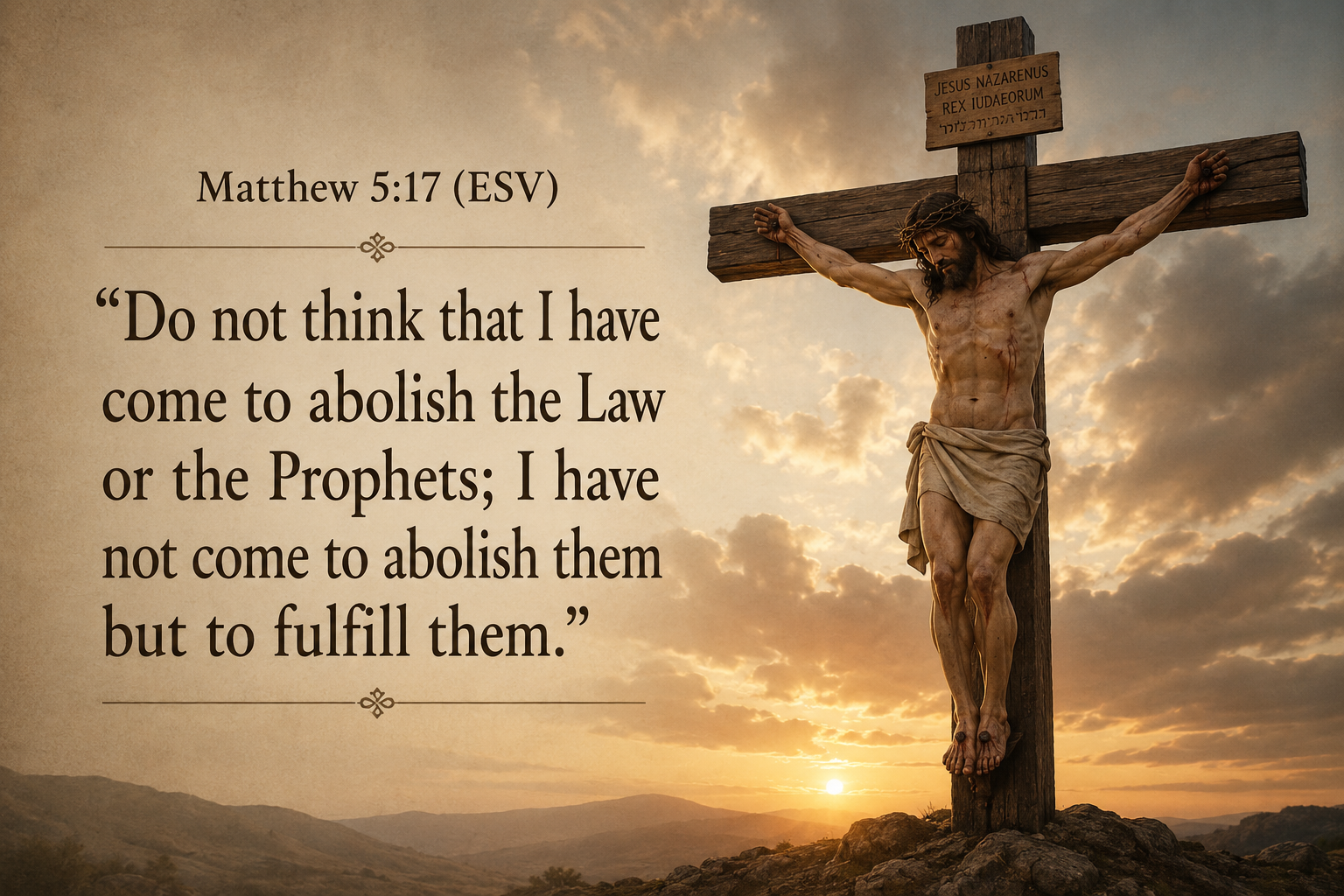
“Do not think that I came to abolish the Law or the Prophets,” Jesus says. Now why would the people think that? Where would they get the idea that Jesus might be teaching something against the Law or the Prophets? Well, consider how different Jesus was from the legalistic religious leaders of His day. He ate with tax collectors and sinners. He healed on the Sabbath. He touched the unclean and diseased. He preached repentance and forgiveness, the lovingkindness and mercy of God. In this sense He was a bit of a radical. And so some may have drawn the false conclusion that He was casting aside the Old Testament and giving them something altogether different.
In order to dispel any such notion, Jesus says, “I did not come to abolish but to fulfill.” He wasn’t undoing and trashing the Law and the Prophets; rather, He was bringing them to their perfect expression and realization in Himself. Everything written in the Old Testament comes to its pinnacle and culmination in Jesus.
And so He says, “Whoever relaxes one of the least of these commandments, and teaches others to do the same will be called least in the kingdom of heaven.” To relax the commandments is to say that as long as you do your best, as long as you do what is in you, that’s good enough; God will accept that. “Oh, that person really was a jerk to you; it’s OK to speak an angry word or to be a little bitter.” “Oh, you’re engaged; it’s OK to have sex before marriage.” “Oh, you’ve got a busy life; it’s OK to skip church.” But that’s now how the Law speaks. Rather, it says, “Whoever keeps the whole Law and yet fails in one point has become guilty of all if it” (James 2).
Another way of relaxing the commandments is simply to say that they no longer apply to today’s contemporary world, that Scripturally-based definitions of marriage and gender can be set aside, that times have changed and church teaching has to change with them. But those who say such things, even under the guise of love and inclusiveness, are acting against Christ. Again, He didn’t come to abolish the Law but to fulfill it.
And we should be careful to apply this not only to others out there, but also to us in here. We know well the temptation to brush aside God’s Law, to think to ourselves, “Even though this is wrong, even though it breaks a commandment, I can go ahead and do it anyway because God will forgive me.” We in effect destroy God’s Law when we misuse His grace in that way, as an excuse to live however we please.
St. Paul addresses this in the Epistle. “Shall we continue in sin that grace may abound? Certainly not! How shall we who died to sin live any longer in it?” God’s forgiveness is not a license to sin, it’s freedom from sin. It’s the taking away of sin. Why would we want to embrace again the very things which once condemned us to hell? Since the old Adam still hangs around our neck, tempting us to think lightly of sin, the Law is still in force in this fallen world. Not one iota or dot will pass from it till all is fulfilled at Christ’s return.
The commandments still call us all to repent. For listen to what Jesus says, “Unless your righteousness exceeds that of the scribes and Pharisees, you will never enter the kingdom of heaven.” You’ve got to do even better than those who dedicated their whole lives to keeping God’s Law down to the finest detail, otherwise you can forget about eternal life. God isn’t simply after good outward behavior, He seeks inward righteousness, a keeping of the Law from the heart, not for the sake of yourself, but out of faith toward God and love toward the neighbor. Are you doing that? If not, then you will not enter the kingdom of heaven.
The real purpose of the Law, then, is not to save us but to drive us to repentance and to Christ, who is our only hope and our only Help. For only in Jesus do we receive an inward righteousness before God, the righteousness of faith, where we despair of our own goodness and instead rely on Christ alone. We prayed it in the Introit, “The Lord is my strength and my shield; my heart trusted in Him, and I am helped.” Only in Jesus is there deliverance from the judgment of the Law. For only Jesus has kept the Law without fault or failing. Again He said, “Do not think that I came to destroy the Law or the Prophets. I did not come to destroy but to fulfill (them).” And all of this Jesus did for you and in your place.
It is written in Hebrews, “He was tempted in all points as we are, yet without sin.” Not only did Jesus not do the things that the commandments forbid, He also did do everything the commandments demand. Not only did He not murder or steal or have impure thoughts, but He also perfectly loved His Father in heaven and His neighbor on earth, showing compassion, healing, doing good and teaching the truth to all. Our Lord lived a holy life as our representative and our substitute, so that our unholy lives might be redeemed.
And Jesus also fulfilled the Law by completing all of the old ceremonial requirements regarding the Sabbath and the sacrifices and everything else. Through His holy death and His rest in the tomb, Jesus Himself became our eternal Sabbath rest; and so He says, “Come to Me all you who are weary and burdened, and I will give you rest.” “I release you from the crushing weight of the Law; I give you the peace of being reconciled with God.” And by His once-for-all, final sacrifice as the Lamb of God, Jesus cleansed us from our sin and purified us. All the Old Testament Jewish rules and regulations found their goal in Jesus, who put that all to an end in His crucified body, that the Law might no longer condemn us. We’ve been put right with God again. That’s what Jesus was saying on the cross, “It is finished.” It is accomplished, completed, perfected, fulfilled. All has been done, as Romans 10 declares, “Christ is the end of the Law for righteousness to everyone who believes.” Our Lord is now risen from the dead to give us new life and a sure hope.
That new life, that sure hope is entirely yours in holy baptism. For St. Paul says in the Epistle that by water and the Word you were buried with Christ and raised with Him to a new life. His death counts as your death. The hellish judgment he experienced counts for you too. It’s all done and behind you. Living in Christ, taking refuge under His wings, you are holy to Him; you are protected and kept safe from the power of sin and Satan and from death itself.
That’s how the words of Jesus which seemed to be impossible are now, in fact, true in Him: “Unless your righteousness exceeds that of the scribes and Pharisees, you will never enter the kingdom of heaven.” But now, by faith in Christ, your righteousness does exceed that of the Pharisees, for it has been given to you freely by God’s grace. You have the perfect righteousness of Jesus. The Father has declared you to be righteous in His sight. He didn’t just demand that you straighten out your life, He gave you a whole new life, the life of Jesus that is full and complete and perfect and everlasting. Through Christ you will enter the kingdom of heaven. For you are in Christ, the King of heaven.
Our Lord has brought you through the Red Sea of baptism, out of the house of bondage. Your old selves were crucified with Christ, that you should no longer be slaves to sin. Therefore, reckon yourselves to be dead indeed to sin, but alive to God in Christ Jesus. For just as you have been united with Him in His death, you will surely also be united with Him in the resurrection of the body when He comes again. To Him with the Father and the Holy Spirit belongs all worship, honor, glory, and praise, now and forever. Amen.