

Trinity 11
Luke 18:9-14
✠ In the Name of the Father and of the Son and of the Holy Spirit ✠
In Ephesians 2 it is written that our salvation is not a result of works “so that no one may boast.” But why is it that people boast and brag in the first place? Often it’s simply that they want to be noticed; they want credit. Sure, it is much more satisfying to have your praises sung by someone else, and sometimes you can manipulate that into happening. But what if others won’t do it for you? What if the moment passes by? What if no one pays attention to how hard you’ve worked, how well you’ve done, how clever you’ve been? Braggers brag because they think they have to. If they don’t, they’ll go unnoticed and won’t get the credit or the reward that they feel is owed to them.
I should add here that there is an opposite side of this same coin. The mirror image of bragging is complaining. Complaining wants our sorrows, our injustices, to be noticed. It, too, demands attention and credit and sympathy for the fact that you’re getting worse than you think you deserve. Complainers would be happier if someone else just noticed their injustice and spoke up and defended them. But they can’t wait for that. In the pain they feel, they have to sound off about what they’ve suffered and at least get the credit of that attention.
Both those who brag and those who complain are afraid that no one will care about them, no one will pay attention. One is “Look at me!” the other is “Woe is me!” But at its root it’s the same self-focus. Social media just magnifies all this.
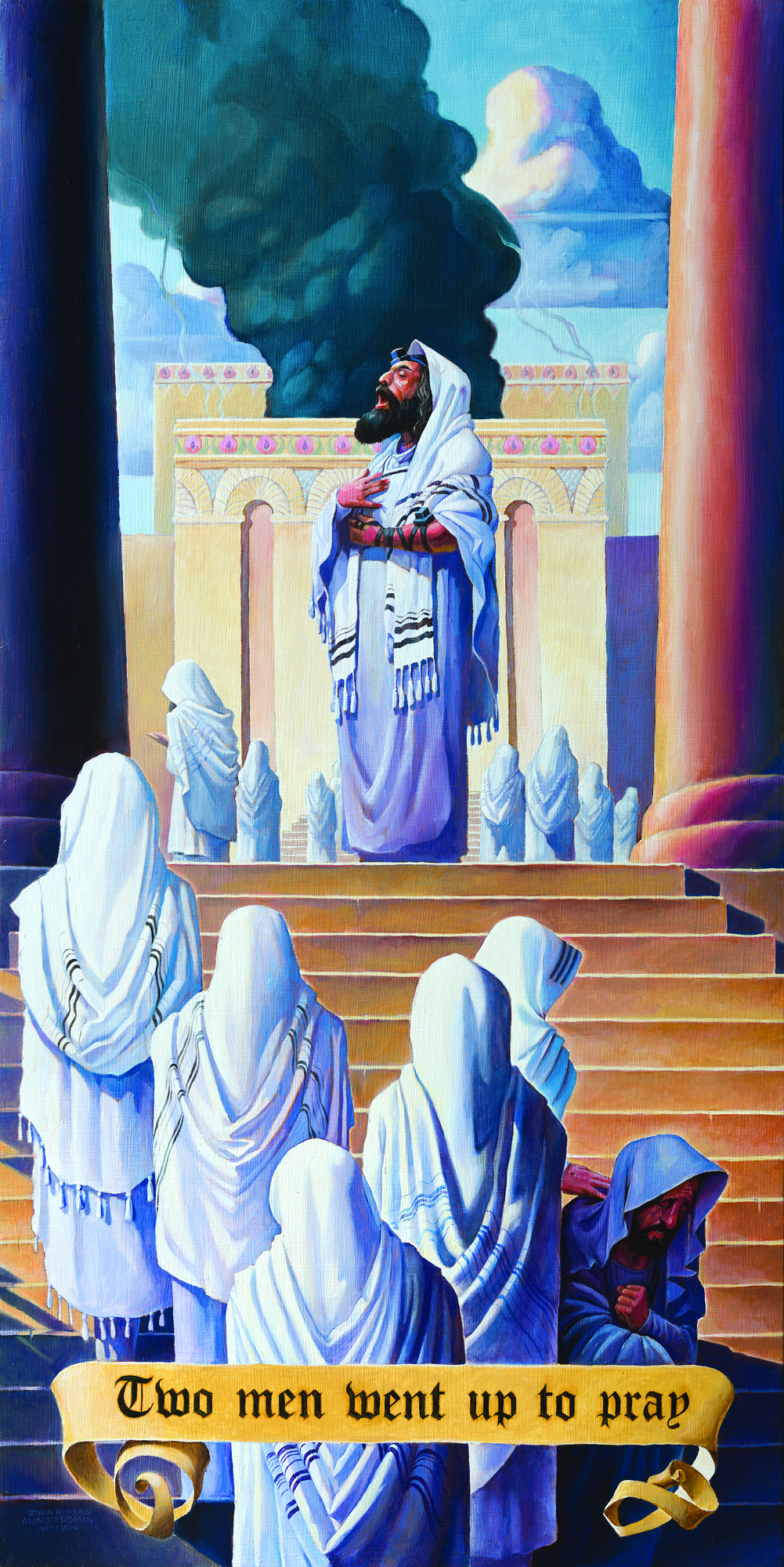
 This attention is what the pharisee wants in the temple. After all, he has disciplined himself, denied himself various vices and pleasures of the flesh. He has not behaved badly like extortioners, unjust men, adulterers, or tax-collectors. And he has made sacrifices as well. He fasts twice a week. He gives a tithe of all he possesses to the Lord. Nothing wrong with that, right? We all would do well to discipline our bodies and give a 10% offering to church.
But what the Pharisee’s heart is set on is not only the notice and honor of people. Especially what he wants is for God to say, “Good job” and give him a little credit and reward. But God is not impressed. God is never all that impressed even with the great works of people, no matter how good you’ve been. After all, what has the Pharisee really done, anyway? He’s no Mother Theresa. The things he has done are really the most ordinary things that he should be doing just as a matter of course. He gave offerings to church. He did without certain foods a couple times a week. The Pharisee just wasn’t an outrageous sinner; he hadn’t embezzled money or had an extramarital affair. But what had he really done that’s so impressive? And who is he to dare to stand before God and boast of his works as if God owed him something? Jesus said in Luke 17, “So you also, when you have done all that you were commanded, say, ‘We are unworthy servants; we have only done what was our duty.’”
Be on guard, then, against trying to draw attention to your own good living and efforts and smarts, either in the eyes of the world or especially in the eyes of God, with the thought you should be receiving some sort of honor or reward. For what sort of worship does that produce? Something God-centered or something self-centered? Notice how it says that the Pharisee prayed by himself. He’s on his own, and it’s all about him, even if God’s name is used. And on the flip side of this, do not dwell on thoughts that your life has been more difficult either, that you have suffered more and therefore deserve more notice and more credit. Everyone suffers and has challenges and heartaches and bruises and fears of their own. Just as everyone has good works of some sort that go unnoticed. In fact, the truly good works are generally the ones that don’t get a lot of attention, anyway. It all comes from God, not you.
Repent, then, and humble yourselves. Humility is the way of life; pride is the way of death. Both bragging and complaining expose the false belief of your old Adam that it’s all about what you do, rather than something that is entirely dependent on the mercy and grace of God. We do not give honor or thanks to God by justifying ourselves and looking down on others. The Pharisee went to the temple to pray. But he went home damned. Let us be warned.
Here’s what really pleases God: It is written, “The sacrifices of God are a broken spirit; a broken and contrite heart, O God, you will not despise.” The Lord certainly did not despise the tax collector like the Pharisee did. For the tax collector comes not in pride but in lowly penitence and faith. This is not fake humility or just going through the motions. The tax collector stands afar off from those praying in the temple; for he knows how his sin cuts him off from God and others. He does not raise his eyes to heaven; for he knows he deserves no heavenly blessing. He beats his chest when he prays in token that he is worthy to be punished severely. He cries out his only hope, “God be merciful to me, a sinner!” Looking to the Lord in that way and with that faith is God-pleasing worship. For the Lord is good, and His mercy endures forever. It is written in Psalm 146, “The Lord lifts up those who are bowed down.”
That truth is what that tax collector staked his life on. He didn’t trust in his own worship or how humble he was. The tax collector’s worship was right before God, because he hated his sin, and especially because he clung to the Lord’s mercy and staked everything on that. He didn’t look within, to his own credentials and powers, but to God’s grace. That faith in the mercy of God is why the tax collector went down to his house justified, righteous in God’s sight, forgiven.
And we shouldn’t forget that the tax collector had something very concrete from God to put his trust in, not just same vague hope. For remember where he was praying. He was in the temple, the place where the animal sacrifices were made that God had given to cover and atone for the sins of the people. That is where the tax collector’s faith was directed. For when he prays, “God be merciful to me, a sinner,” he uses a word for mercy that has to do with the atonement God attached to that sacrificial blood. So right when he makes his plea for mercy, God was answering his prayer on the temple altar.
And in the same way, when you pray, “God, be merciful to me, a sinner,” you also have something very concrete and real to trust in. For on the altar of the cross, the blood of Christ was shed to cover and atone for your sins and the sins of the whole world. All of the sacrifices in the temple were pointing forward to that once-for-all event on Good Friday where your prayers were answered. God is merciful to you, a sinner, in Jesus. It is a mercy that knows no limit and has no end. You are released and entirely forgiven. Just as the blood of Abel the shepherd covered the ground, so the holy blood of Jesus the Good Shepherd covers you who are made of dust. By it you are justified, declared righteous, reconciled to God. As it is written, “You who once were far off [like the tax collector] have been brought near by the blood of Christ.” “By grace you have been saved through faith, and that not of yourselves, it is the gift of God, not of works, lest anyone should boast.”
It’s all yours because of the grace of our Lord Jesus Christ. And that’s true even when it comes to your good works. They, too, have been given to you by grace. For the Epistle said that they were prepared beforehand by God for you to walk in. Christ is the one who is at work in you to do good, to walk by faith, to love your neighbor in the vocations God has put you into. Since it’s all centered in Jesus, bragging no longer applies. For by faith we boast not in ourselves but in the Lord. And complaining no longer applies, either. For our hope is entirely in the Lord’s mercy, and we trust that He is good, and that He works for good even through the crosses and affliction He allows us to bear. We call upon the Lord in our troubles and wait on Him, confident that He will deliver us in the end.
The tax collector points us to where we continually need to look–to the God of mercy who sent His Son to redeem creation from the devil’s power. So if you must boast, boast in the Lord. Even if you don’t have a great story about your conversion, some sort of dramatic turnaround in your life, that’s alright; boast in the Lord. You are forgiven and righteous. If you aren’t particularly popular or well-known, if your home isn’t all that spectacular and needs repairs, if people find you unimpressive and ordinary, that’s alright; boast in the Lord. And if you haven’t done great and newsworthy things for the church, just ordinary faithfulness, boast in the Lord. You do not need spiritual merit badges to show off. You go down to your houses today justified. That is what matters. Jesus loves you. You are not insignificant in heaven. You are the cause of angelic rejoicing. Boast in that and let that be enough.
And if you hunger for honor, find it here at the Lord’s table. For if there would be honor in being invited to eat with a head of state, the king of England, how much more honor is there in being received at the table of the Head and King of creation. You are given to receive the Lord Himself in the supper, and to kneel next to His own saints and loved ones as a family member in the household of God. Take note of those whom you commune with when you come to the Lord’s table today. We do not despise one another, because those gathered here, the baptized, are God’s saints. We learn to see one another as the Lord does. And then, finally, learn to see yourself also as God sees you in Christ. Because your Lord does notice you, and He loves you and delights in you.
✠ In the name of the Father and of the Son and of the Holy Spirit ✠
(With thanks to David Petersen)
(“Two Men Went Up to Pray” by Edward Riojas. Used with permission)