Matthew 7:13-23
Trinity 8
✠ In the name of the Father and of the Son and of the Holy Spirit ✠
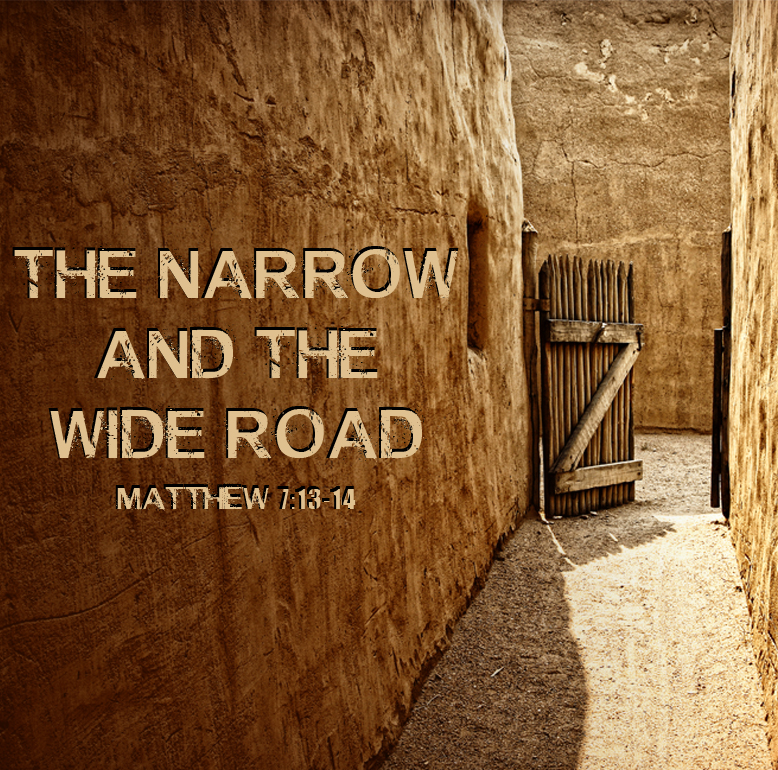
There are only two paths that you can take in this world–one is the way of life, and the other is the way of death. The path that leads to destruction is wide and easy and usually feels right to us. It is the path of least resistance. Just as water naturally flows in the most downward direction, wherever the land takes it, so the way of death is the path that fallen humans naturally take. It is the way of the world which follows the crowd and goes with the flow and doesn’t want to rock the boat too much. It is that desire in you to do what is easy rather than to do what is right, to do just enough to get by rather than to do to the best of your God-given abilities, to please people rather than to please God, to love yourself more than Him. The wide and broad way of destruction leads people like lemmings over the cliff.
The path of life, on the other hand, is narrow and difficult and is often contrary to what feels right. It is usually the path of most resistance. It involves going against the flow, following the Word of God and not the crowd, swimming upstream, like salmon using every ounce of energy to leave the salt water and return inland to the fresh water streams and pools in which they were spawned. Jesus said, “If anyone desires to come after Me, let him deny himself, and take up his cross, and follow Me. For whoever desires to save his life will lose it, but whoever loses his life for My sake will find it.” The way of life is narrow because it is found exclusively in Christ who said, “I am the Way, and the Truth, and the Life. No one comes to the Father except through Me.” This path is hard because it is the way of the cross, dying to the self so that you might have real life through faith in Him.
This is the path that baptism sets us on (and that Taylor began today). It may not sound desirable at first, but you go to baptism to lose your life in order to gain eternal life with God. Romans 6 says that when you’re baptized, you’re crucified with Christ; you’re baptized into His death. However, that is actually very good news! Because it means that His sacrifice counts for you. Your sins are paid for by His cross. God’s judgment against you has been taken away in Jesus. And it’s also good news because that same passage says this as well, “If we have been united with Him in His death, we will certainly also be united with Him in His resurrection.” In baptism we begin to live a different life, the new life of Christ.
As you seek to walk this path, Jesus here gives you a warning, “Beware of false prophets.” There will be those along your journey who will seek to lure you off the narrow way. They will speak false things to you to divert your attention from Christ and His unchanging truth. They will say, “Surely there has to be more than one road to everlasting life. All religious roads lead to heaven, as long as you’re a good person. Don’t be so narrow minded. Isn’t all this Christianity stuff just a little bit extreme? Come back to the mainstream. Join us on the broad road. We’re spiritual, too; we just take our religion in moderation. Be a little more inclusive and open-minded.” The problem is, they want you to be inclusive and open to what is false and damnable to God and contrary to His Word.
The reality is that our culture doesn’t want to believe that there is really much of anything out there that is false when it comes to spirituality and religion. As long as it fills your needs and makes you happy and doesn’t hurt anyone else, what’s the problem? But then Jesus says very clearly, “Beware of false prophets.” If there is such a thing as a false prophet, then there is also such a thing as false teaching and false religion and false spirituality. Those who engage in such things may be sincere, but they are sincerely wrong and sincerely in danger. For what they are practicing doesn’t lead to life but to death. “The road to hell is paved with good intentions.”
So how do you recognize a false prophet? The first thing to understand is that they’re not going to look like a false prophet. They’re not going to be wearing a sign around their neck that says “mouthpiece of Satan.” No, Jesus says here that they come to you in sheep’s clothing. In other words, they come looking like one belonging to the Good Shepherd, like fine, pious, upstanding Christians to whom you should be paying attention. But inwardly, Jesus says, they are ravenous wolves. They want to take the true sheep from their Shepherd and devour them. The devil comes as an angel of light, and so do his false preachers. The thing that makes a lie powerful is when it masquerades as the truth.
Some have suggested that the sheep’s clothing may be a reference to an OT practice, where prophets would wear a sheepskin over their shoulders, a mantle, as with Elijah and Elisha. This was a sign of their office as those who spoke the Word of the Lord. In other words, these false prophets come to you looking like servants of the Lord. They are preachers and teachers in the church. They’re nice people. They may even wear a collar.
Remember Scripture says that the Antichrist sets himself up in the church. The most deceptive, heretical teaching comes not from worldly charlatans, but from people who have a position of authority in the church–the unmanly bishop or the female false pastor who are all about fluffy acceptance and who can’t muster a single word calling people to repentance for their sin; or the hard-edged conservative who emphasizes personal holiness and obedience to the Law at the expense of the grace of Christ; or the businessman pastor who twists the Scriptures into a guidebook for how to have a life of personal success and prosperity. Throughout history much of the false teaching that has arisen in the church has come from properly called and ordained men. St. Paul said to the pastors in Ephesus that some from among them would rise up, speaking perverse things, to draw away followers after themselves. Notice the self-serving goal there. Jeremiah said that these prophets speak a vision of their own heart, not from the mouth of the Lord. They don’t preach the truth but what the people want to hear. They are wolves, even if they don’t know it.
And Jesus teaches that at least some of them really don’t know it. “On that day many will say to me, ‘Lord, Lord, did we not prophesy in your name, and cast out demons in your name, and do many mighty works in your name?’ And then will I declare to them, ‘I never knew you; depart from me, you workers of lawlessness.’” They are law-less; that is, they are without the true teaching of Christ, in which alone there is salvation.
That’s ultimately how you can tell a false prophet from a true one, not by the wonders he can do or his charisma or success, not even by how loving he is, but by what he teaches, whether it is the Gospel of Christ’s freely given grace or something else. Jesus says, “By their fruit you will recognize them.” The fruit refers not to their deeds (which can deceive) but to their doctrine. What spiritual food do they offer? What do they hold forth for your souls to feast upon? I John 4 says, “Beloved, do not believe every spirit, but test the spirits, whether they are of God; because many false prophets have gone out into the world.” It is written in 2 John, “Whoever does not abide in the doctrine of Christ does not have God.” “By their fruits you will recognize them.”
So in the midst of all the religion talk and God-talk that you hear, ask yourself, is the focus on me, or is it on what Christ has done for me? Is it about how I can have a better life in this world through my spirituality, or is it about how I can have a new life in Jesus solely through His holy suffering and death and resurrection?
And if you want to know whether a teacher is true or false, just ask yourself: Does he direct me to the shifting sands of my own heart, or does he direct me to the solid rock of Christ’s commitment to me and His sure baptismal promise which I have been given? Does he direct me to my own good works as a way of gaining eternal life, or does he direct me to the all-sufficient sacrifice of Christ on the cross? Does he only speak of things in spiritual terms, or does he emphasize the concrete realities of the faith, that Christ took on our flesh and blood, that He was raised from the dead in the body, that He comes to us now with His true body and blood for our forgiveness in the Sacrament, that we will be raised bodily on the Last Day?
Again Jesus said, “Not everyone who says to Me, ‘Lord, Lord,’ shall enter the kingdom of heaven, but he who does the will of My Father in heaven.” And the will of the Father is all wrapped up and centered in Jesus. It is written in John 6, “This is the will of (the Father) who sent Me, that everyone who sees the Son and believes in Him may have everlasting life; and I will raise him up at the last day.” That’s what it means to do the will of the Father, to cling to Christ as the way of life, to believe in Him and stake your life on Him. He alone is the way into the kingdom of heaven, He who is fully God and fully man, made flesh, who was crucified, resurrected, and ascended for the salvation of sinners. The will of God is fulfilled in Jesus for you.
So beware of false prophets who teach something different than the faithful pattern of Scriptural words that you’ve been given in the catechism and the creeds. Beware of those whose teaching doesn’t square with the liturgy and the preaching of the Word that you hear in this place. Even if you can’t quite put your finger on what’s wrong, flee from them; and flee to Christ. Take refuge in Him, give attention to His words. Follow that narrow way of Him who is Way, the Truth, and the Life. Go through the narrow gate which is the cross. For though the cross involves death to sin and self, it is also the entrance to light and life. It is the only gate that leads to the resurrection. For there on the cross Jesus conquered the lies of the devil and the death which sin brings. Believing in Him, you are completely forgiven. You are raised to new life in Him. That is the truth. For it is written, “Christ Himself bore our sins in His own body on the tree, that we, having died to sins, might live for righteousness,” the everlasting righteousness, innocence, and blessedness of Christ.
Brothers and sisters of Christ, truly the cross is that good tree that bears good fruit. For it bore the very body and blood of the Lord Jesus for your salvation. Here today you are given to partake of those fruits in the Holy Supper and bask in the forgiveness of all your sins. Jesus is your true Prophet and the fulfillment of all prophecy. By His fruits you will recognize Him.
✠ In the name of the Father and of the Son and of the Holy Spirit ✠