Acts 2:1-21
Pentecost
✠ In the name of the Father and of the Son and of the Holy Spirit ✠
Fire can cleanse, and fire can destroy. Fire can serve good purposes, like keeping us warm or purifying metal; or it can do serious harm, like burning your hand or reducing a house to ashes. God appears to Moses in the burning bush, which is aflame but is not consumed. Hell is described as a lake of fire and unspeakable torment for those who have rejected Him. So we must learn to distinguish between the fire that is from God for good, and the fire that works against Him for evil.
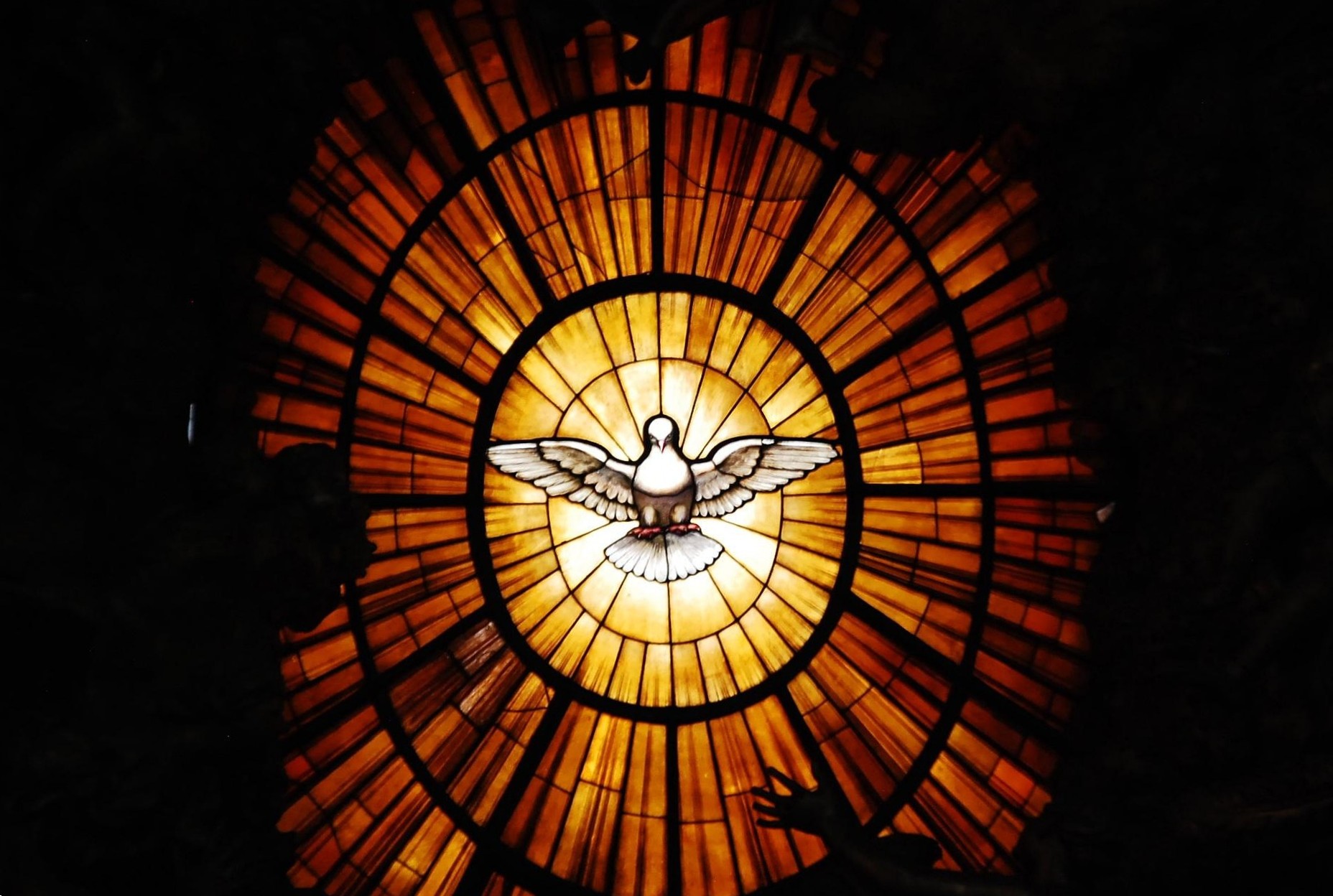
Exactly 7 weeks after Easter, on the 50th day of Easter, tongues of fire came to rest on the apostles as they were gathered together in the upper room. They began to speak with other tongues as the Holy Spirit gave them utterance. Simple Galileans, recognizable by their northern accents, spoke with fiery boldness in the mother tongues of all those who were gathered there in Jerusalem from all over the world, proclaiming the wonderful works of God in Christ in many different languages.
However, we also hear in the Scriptures of another fire of tongues. James writes, “The tongue is a little member and boasts great things. See how great a forest a little fire kindles! And the tongue is a fire, a world of unrighteousness.” (3:5-6)
So there are two kinds of tongues and two kinds of fire here. First, there is the tongue of the Word of God, whose fire is the Spirit of God. Second, there is the tongue that is set within our bodily members, whose fire is hell. The devil always tries to copy and mimic God, but in an upside down and destructive way. Though both of these are fiery tongues, they stand in diametrical opposition to one another.
We know all too well how our tongues and speech can be used in ways that are contrary to God and that manipulate things to our advantage. We know what it feels like to share gossip that spreads like wildfire. We know what it’s like to deceive by not quite telling the whole truth, to spin things to make ourselves look better or cover up our sin. And we know what it’s like to use our tongues to cut others down rather than to build others up. Again James writes, “The tongue is full of deadly poison. With it we bless our God and Father, and with it we curse men, who have been made in the similitude of God. Out of the same mouth proceed blessing and cursing. My brethren, these things ought not to be so” (3:8-10). Rather, St. Paul says, “Let no corrupt word proceed out of your mouth, but what is good for necessary edification, that it may impart grace to the hearers” (Ephesians 4:29).
That’s what the problem was with the people at Babel. They didn’t use their tongues to impart the grace of God or glorify Him, but to glorify and exalt themselves. They said, “Come, let us build ourselves a city, and a tower whose top is in the heavens; let us make a name for ourselves.” Not wanting to receive the identity that God had given them, they engaged in the religion of following the dreams of their own hearts. But that is a devilish doctrine. It is a hellish tongue which teaches you to follow your heart and to pride yourself in your own choices and achievements.
Today’s towers aren’t made from bricks and bitumen but silicon chips and computer hardware. There’s nothing inherently wrong with any of these things, of course, just as there’s nothing inherently wrong with building a skyscraper. Such things can serve good purposes. But sinful humans inevitably corrupt these things and twist them toward self-exaltation. Artificial intelligence is the tower we’re presently constructing. No doubt it can and will sometimes be used in good ways. But it’s worth noting on this Pentecost that a big part of AI is what is referred to as an LLM, a large language model that it uses and manipulates and applies. At its root AI is about words and how words are used. Words are the heart of what makes us human, for we are created in the image of the Word made flesh. The problem is that AI creates things in the image of fallen human beings, using the corrupted words and wisdom of fallen creatures. In the end this will not magnify God’s glory but man’s hubris and pride. Already now, we stupidly think we’re the smartest version of humanity that has ever existed, all while fewer and fewer college students can’t write a coherent 10 page paper unless it’s generated by ChatGPT or Claude. In our pride we’re being artificially dehumanized. And so as He did at Babel, still today God throws a monkey wrench into our tower-building. Now and again, He confuses and scatters us in our rebellion. He does this so that we might learn humility and be brought to repentance before Him.
And that brings us to the good news of Pentecost. The Divine Intelligence that formed this universe and holds it together by His wisdom puts to shame the artificial and self-glorifying intelligence of man. God undoes the destructive, fiery tongue of man with His own constructive, fiery tongue of life. Pentecost is the undoing of Babel. At Babel God said in judgment, “Come, let us go down and confuse their language.” At Pentecost God the Father said in mercy to His only begotten Son, “Come, let us go down and pour out our Spirit on them, so that the words of the Gospel might be clearly proclaimed to them in their own language. Let their ears be opened so that they may not be confused but may understand and receive the forgiveness and salvation which you, my beloved Son, won for them on the cross.”
And so it was that there was a sound of a rushing, mighty wind and tongues of fire on those gathered together for worship on that Sunday morning. God was blowing the breath of His Spirit across the embers of His little band of disciples to stir up the flame of the Church. And what was the result of that? Words, speaking, preaching. That’s what the Holy Spirit is all about. The church is a mouth house, where the Holy Spirit proclaims the Gospel from the mouth of a preacher, and believers confess that Gospel with their mouth and praise Jesus with words and song.
Our tongues must be purified with the Spirit’s refining fire to do that. Recall the prophet Isaiah, who saw the Lord lifted high and exalted upon His throne. Isaiah said, “Woe is me! For I am lost; for I am a man of unclean lips, and I dwell in the midst of a people of unclean lips; for my eyes have seen the King, the Lord of hosts.” Isaiah knew that his lips were soiled by sin and needed to be cleansed. Then one of the fiery seraphim swooped down to the incense altar and took a fiery coal and touched it to Isaiah’s lips, and he absolved him. “Your guilt is taken away, your sin is purged,” the angel said. Isaiah’s mouth was purified by fire.
That burning coal is a picture for us of the Word and fiery Spirit of our God. To those who cry out in penitence with Isaiah saying, “Woe is me; for I am lost!” “Lord, deliver me from my sin,” the Holy Spirit comes with the live coal of Christ’s Word and purifies our lips and cleanses us of our sin. The same Jesus who purified our human nature by becoming man, the same Jesus who felt the fires of hell for us on the cross and suffered the inferno of God’s judgment to redeem us and save us, the same Jesus who rose from the dead on the third day to give us victory over the grave and everlasting life–He now pours out His Holy Spirit to deliver those gifts of salvation to you through His Word and through the Sacraments. John the Baptist preached that “Jesus will baptize you with the Holy Spirit and fire.” And truly the Holy Spirit is a cleansing fire, who purges you of all iniquity through the precious blood of Christ.
That’s what the Holy Spirit was all about at the first Pentecost; and that’s He’s still about today. The main thing that happened on Pentecost was not the signs of the rushing wind and the fire, but the preaching and the baptizing that the Holy Spirit did through the apostles. Most of Acts chapter 2 is the sermon which Peter spoke that day. By the Spirit’s power, He condemned the people for their unbelief in Christ and their wickedness in putting Jesus to death. Yet Peter also proclaimed how God accomplished His saving purposes through Christ’s death, and how the Father raised Jesus from the dead as Lord of all and the only Savior. When the people heard this, they were cut to the heart in sorrow for their sin, and they said to the apostles, “What shall we do?” Peter replied, “Repent and be baptized, every one of you, in the name of Jesus Christ for the forgiveness of your sins. And you will receive the gift of the Holy Spirit.” About 3,000 people were baptized that day from all different lands and languages, who carried that Spirit-filled Gospel home with them, spreading it like a prairie brush fire. And of those who remained in Jerusalem, it is written that they devoted themselves to the apostles’ teaching and fellowship, to the breaking of bread in the Lord’s Supper, and to the prayers.
So we may not have the sound of the rushing of the wind and the tongues of fire any longer–those were one-time signs marking the first outpouring. But the Spirit is still at work fanning the flame of faith and love to glow brightly among God’s people. The Holy Spirit continues to be poured out in baptism, which is the new birth of water and the Spirit. The Holy Spirit continues His ministry of calling people to repentance and preaching the life-giving Word of Christ. And the Holy Spirit continues to place the fiery Word on your tongue by giving into your mouth the body and blood of Christ, the Word made flesh, for the forgiveness of your sins. In these ways the Holy Spirit opens your lips, that you may pray to God, praise Him, and give Him thanks in true faith. For “whoever calls on the name of the Lord shall be saved.”
Pentecost is still continuing. It goes on whenever the Bible is translated into a new language or whenever a missionary carries the Gospel to people in their own mother tongue. Just the fact that we can even hear the Gospel in English right now is a sign of the working of the Holy Spirit. The forgiveness of your sins, purchased for you by a man who spoke Aramaic and Hebrew, preached by apostles who spoke Greek, confessed by much of the early church which spoke Latin, has come to you in your own language, English, a Gentile tongue. That’s God’s gift to you. There’s no more personal way of saying that Jesus is your Savior from sin and death than to say it in your own language. Jesus is for you. You can be sure of it because you are hearing it in your own native tongue.
Let us then, today and always, speak that language which the Holy Spirit has taught us, the language of faith. For it is written, “No one can say Jesus is Lord except by the Holy Spirit.” Let us use our tongues to sing and proclaim the wonderful deeds of our Savior, who has called us out of darkness into His marvelous light. May our prayer ever be, “Come, Holy Spirit, fill the hearts of the faithful, and kindle in the them the fire of your love.”
✠ In the name of the Father and of the Son and of the Holy Spirit ✠